
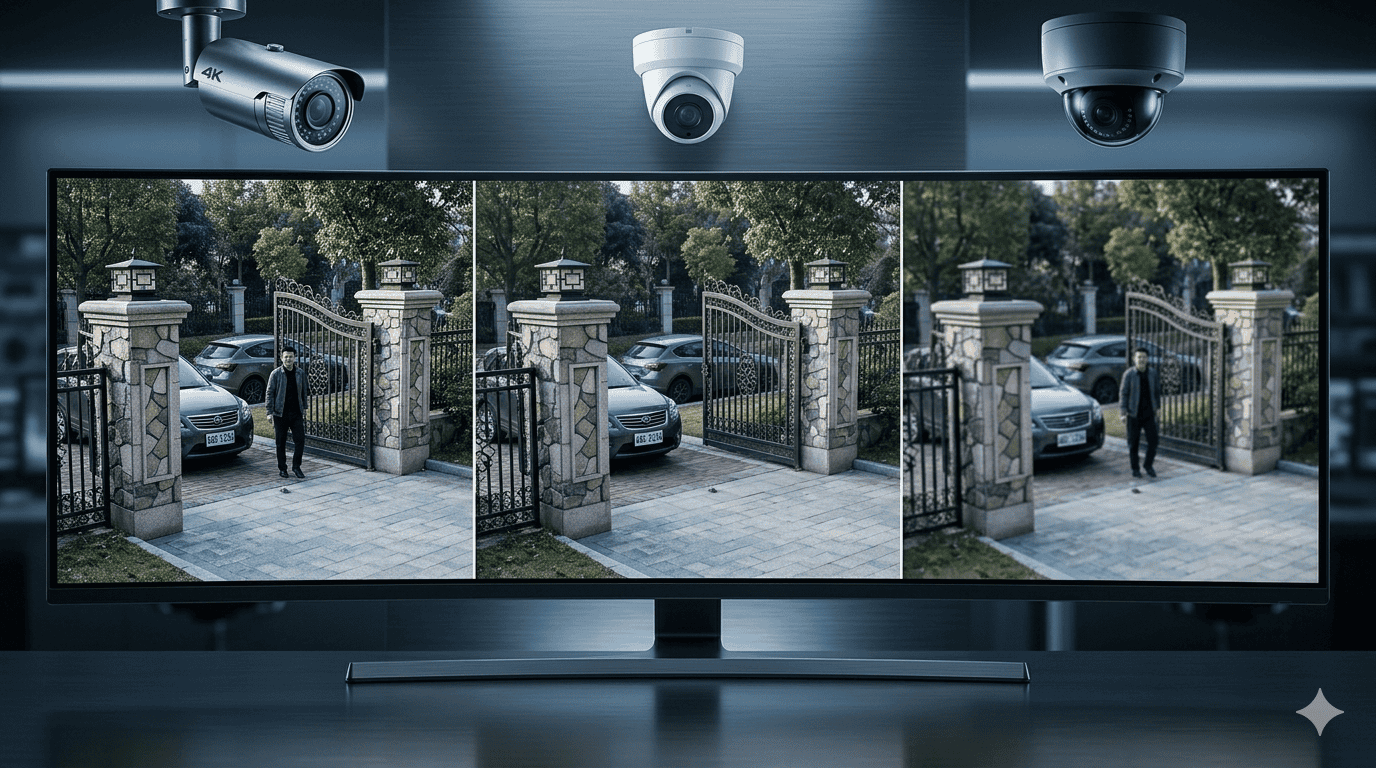
Understanding CCTV Resolution: 4K vs 1080p vs 720p — What Actually Matters for Your Security
Resolution is one of the most misunderstood specs in CCTV. Salespeople use it to justify higher prices. Manufacturers use it to win spec-sheet comparisons. But for most homes and businesses in Kenya, the choice between 720p, 1080p, and 4K is less about raw pixel count and more about what you actually need to see — and how much storage you’re willing to budget for. This guide explains it plainly.
What Is CCTV Resolution?
Resolution refers to the number of pixels that make up each frame of video. A pixel is the smallest unit of an image — think of it as a tiny coloured dot. Pack more dots into the same frame and you get a sharper, more detailed image. Pack fewer in and the picture looks softer, with less ability to distinguish fine details at a distance.
In CCTV, resolution is expressed in two ways. The first is the pixel grid — for example, 1920×1080 means 1,920 pixels wide by 1,080 pixels tall. The second is megapixels (MP), which is simply that grid multiplied: 1920×1080 equals roughly 2 million pixels, so it’s called a 2MP camera. These two ways of expressing resolution describe exactly the same thing — they’re just different conventions used by different parts of the industry.
What matters practically is what that pixel count lets you do. A higher resolution camera gives you more detail to work with when you zoom into footage — which is often the most important thing you need after an incident, whether you’re trying to identify a face, read a number plate, or confirm what someone was carrying.
720p, 1080p, and 4K — The Numbers Explained
Here is what each common resolution standard actually means, stripped of marketing language:
| Resolution Name | Pixel Grid | Megapixels | Also Called |
|---|---|---|---|
| 720p | 1280 × 720 | ~1MP | HD, High Definition |
| 1080p | 1920 × 1080 | ~2MP | Full HD, FHD |
| 1440p / 2K | 2560 × 1440 | ~4MP | 2K, Quad HD |
| 4K / Ultra HD | 3840 × 2160 | ~8MP | 4K, UHD, 8MP |
A few things worth noting from that table. First, 4K has four times the pixels of 1080p — not twice. People often assume 4K is just a step up, but it’s actually a substantial jump in data. Second, the 4MP (1440p/2K) tier sits between 1080p and 4K and is increasingly common in professional installations — it offers meaningfully better detail than 1080p without the full storage demands of 4K. Third, when suppliers in Kenya refer to “2MP cameras,” they mean 1080p — the terms are completely interchangeable.
What About Analog Cameras?
Older analog CCTV systems measured resolution differently — in TV lines (TVL) rather than pixels. Standard analog cameras topped out at around 420–700 TVL, which is well below even 720p by modern standards. Today’s analog HD cameras (AHD, TVI, CVI formats) can support 1080p and even 4MP and 8MP resolution, though they still require coaxial cable and a DVR. When someone says “analog” in Kenya’s market today, they almost always mean analog HD — not the old low-resolution format.
What the Difference Actually Looks Like
Pixel counts are abstract. What does the difference actually mean when you are watching footage or reviewing a recording after an incident?
720p: Adequate for Overview, Limited for Detail
At 720p, you can clearly see that a person is present, track their general movement, and identify broad characteristics like clothing colour and rough build. What you struggle with: faces from more than 3–4 metres away, number plate characters at any meaningful distance, and distinguishing between people with similar builds or clothing. For basic indoor monitoring of a small space — a stockroom, a till area — 720p is functional. For anything where identification matters, it is not enough by today’s standards.
1080p: The Sweet Spot for Most Kenyan Homes and SMEs
At 1080p, you get genuinely useful detail. Facial features are clear within reasonable distances — up to 6–8 metres for a fixed camera. Number plates are legible at standard gate or entrance distances. Zooming into footage digitally still leaves you with a usable image. This is the resolution most professional installers in Kenya default to for homes, small offices, and retail premises, and for the vast majority of use cases it is entirely sufficient.
4K (8MP): Maximum Detail, Real Trade-offs
At 4K, the level of detail is genuinely impressive. A single 4K camera can cover an area that would require two or three 1080p cameras to monitor at the same detail level. Zooming into 4K footage digitally still leaves you with a sharp image — something that breaks down quickly with 1080p and catastrophically with 720p. Number plates are legible at 15–20 metres. Faces are identifiable at distances that 1080p simply cannot match.
But 4K also produces four times more data per camera than 1080p. That has direct implications for hard drive size, network bandwidth for IP systems, and the hardware required to process and display footage without lag.
“The question is not which resolution is best in absolute terms. It is which resolution gives you enough detail to do what you actually need — at a storage cost your budget can sustain.”
How Resolution Affects Storage — and Why It Matters in Kenya
Storage is where resolution choices have the most direct financial impact. Every resolution tier roughly doubles the data generated per hour of recording compared to the tier below it. Here is what that looks like in practice, using H.265 compression — the current standard for most professional cameras in Kenya:
| Resolution | Data per Camera per Hour | HDD for 4 Cameras / 30 Days | HDD for 8 Cameras / 30 Days |
|---|---|---|---|
| 720p (1MP) | ~0.5 – 0.8 GB | ~1.5 – 2.5 TB | ~3 – 5 TB |
| 1080p (2MP) | ~0.9 – 1.5 GB | ~2.5 – 4.5 TB | ~5 – 9 TB |
| 4MP (2K) | ~1.5 – 2.5 GB | ~4 – 7.5 TB | ~8 – 15 TB |
| 4K (8MP) | ~3 – 5 GB | ~9 – 15 TB | ~18 – 30 TB |
A few things stand out from those numbers. Running a full 30-day retention period at 4K across an 8-camera system requires 18–30TB of storage — which means either multiple hard drives or expensive enterprise-grade drives. Most Kenyan homes and small businesses run 7–14 days of retention at most, which brings these numbers down considerably. H.265 compression versus the older H.264 cuts storage requirements by roughly 40–50%, so always confirm which compression format your DVR or NVR supports before specifying hard drive capacity.
Most DVRs and NVRs let you set different recording modes — continuous, motion-triggered only, or scheduled. Switching from continuous to motion-triggered recording can reduce actual storage consumption by 60–80% for a typical property, making 4K storage demands much more manageable without sacrificing coverage.
Hard Drive Costs in Kenya by Resolution Requirement
| System Setup | Recommended HDD | HDD Cost (KES) |
|---|---|---|
| 4 cameras at 1080p, 14 days | 1TB WD Purple | 7,000 – 9,500 |
| 4 cameras at 1080p, 30 days | 2TB WD Purple | 10,000 – 14,000 |
| 4 cameras at 4K, 14 days | 4TB WD Purple | 16,000 – 22,000 |
| 8 cameras at 4K, 30 days | Multiple drives or NAS | 40,000 – 80,000+ |
For most home installations in Kenya, 1080p with a 1TB or 2TB drive gives you 7–20 days of footage — more than enough to cover the period between most incidents and their discovery. For businesses with longer investigation timelines or compliance requirements, 2TB at minimum with motion-triggered recording is the sensible starting point.
Bandwidth and Network Demands
This section is relevant specifically for IP camera systems — where cameras stream footage over a network to an NVR or cloud storage. For analog systems connected by coaxial cable, bandwidth is not a concern.
Higher resolution IP cameras generate more data per second, which means they consume more network bandwidth. This matters in two scenarios: remote viewing over the internet — watching cameras on your phone while away from the property — and multi-camera setups where all cameras share the same network infrastructure.
| Resolution | Bandwidth per Camera | 4-Camera Total | 8-Camera Total |
|---|---|---|---|
| 720p (H.265) | ~1 – 2 Mbps | ~4 – 8 Mbps | ~8 – 16 Mbps |
| 1080p (H.265) | ~2 – 3 Mbps | ~8 – 12 Mbps | ~16 – 24 Mbps |
| 4MP (H.265) | ~3 – 5 Mbps | ~12 – 20 Mbps | ~24 – 40 Mbps |
| 4K / 8MP (H.265) | ~6 – 10 Mbps | ~24 – 40 Mbps | ~48 – 80 Mbps |
For Kenyan internet connections — where fibre in Nairobi runs at 10–100 Mbps and mobile data is the fallback in many areas — bandwidth becomes a genuine constraint for 4K multi-camera systems when remote viewing is required. Most modern IP cameras and NVRs handle this intelligently by automatically lowering the resolution of the remote stream while maintaining full resolution on the local recording. You might view 720p on your phone while the NVR records in 4K locally. This is sensible default behaviour and not a sign anything is wrong with the system.
Does Resolution Affect Night Vision?
This is a common question that deserves a direct answer: resolution and night vision are separate camera attributes. A high-resolution camera does not automatically have better night vision. In some cases, a lower-resolution camera with a larger sensor and better IR LEDs will outperform a higher-resolution camera in low-light conditions.
What determines night vision performance is sensor size and sensitivity, the quality and range of infrared LEDs, the lens aperture (lower f-number means more light), and whether the camera supports full-colour night vision — also called Starlight or ColorVu technology on Hikvision products. These are specifications you need to check separately from resolution.
Many properties in Nairobi and surrounding areas rely on CCTV specifically for night-time deterrence and incident recording — when most perimeter breaches occur. Do not sacrifice night vision quality chasing a higher resolution number. A 1080p camera with excellent low-light performance will deliver more useful footage at 2 AM than a 4K camera with poor IR range pointed at the same spot.
When reviewing camera specifications, look for: IR range in metres (30m, 40m, 60m), colour night vision support, and minimum illumination rating in lux — lower is better, with 0.001 lux being excellent and 0.1 lux being average for standard IR cameras.
Which Resolution for Which Situation?
Rather than a blanket recommendation, here is a scenario-by-scenario breakdown based on real Kenyan installations:
| Location / Use Case | Recommended Resolution | Reason |
|---|---|---|
| Small apartment, indoor only | 1080p (2MP) | Sufficient detail, minimal storage impact |
| Standard home — gate, driveway, perimeter | 1080p – 4MP | 1080p for general coverage, 4MP at gate for number plates |
| Large compound or plot | 4MP – 4K | Wider field of view per camera, more detail at distance |
| Retail shop (till, entrance) | 1080p – 4MP | Face and transaction detail at short to medium range |
| Supermarket or warehouse | 4MP – 4K | Large spaces need wider FOV and useful detail at distance |
| Petrol station or car park | 4MP – 4K | Number plate capture requires higher resolution at distance |
| School compound | 1080p – 4MP | Balance of coverage area, storage budget, and identification |
| Office corridor or reception | 1080p | Short range, controlled environment — 1080p fully sufficient |
| Bank or cash handling area | 4K | Maximum detail for transaction recording and evidence quality |
| Apartment block entrance or lobby | 4MP – 4K | Resident identification, visitor logging, evidence quality |
Many professional installations in Kenya use a mixed approach — 1080p for general coverage cameras and 4MP or 4K specifically at key identification points like main gates, entrance doors, and cash handling areas. This balances storage costs against the detail you actually need where it matters most.
The Kenya Context: What Most Installations Actually Use
Understanding what is common in the local market helps calibrate expectations and avoid both over-specifying and under-specifying.
Homes in Nairobi (Kasarani, Ruaka, Kiambu, Syokimau)
The standard residential installation in Kenya today is built around 2MP (1080p) cameras — typically 4 cameras on a DVR with a 1TB or 2TB hard drive. This has been the professional baseline since around 2020 when 1080p prices dropped to the level that 720p occupied before it. Very few reputable installers still specify 720p cameras as their standard offering. If you are being quoted a “1MP HD system” in 2026, ask why — you are likely being sold old stock or a budget cut that will cost you more in the long run.
SMEs and Commercial Properties
4MP cameras are increasingly common for commercial installations, particularly at entrance points, parking areas, and cash-handling locations. 4K adoption is growing but still represents a minority of installations — primarily in banks, fuel stations, apartment blocks, and higher-end commercial premises where evidence quality justifies the additional storage infrastructure cost.
The 720p Market
720p cameras are still sold in Kenya’s market — primarily in budget kits targeting the price-sensitive end of the residential segment. They are functional for basic presence monitoring but represent poor long-term value. The price difference between 720p and 1080p cameras today is KES 500–1,500 per camera — too small to justify the significant capability gap. Avoid specifying them in new installations unless budget is genuinely the only constraint.
What Resolution Cannot Tell You
Resolution is the most heavily marketed camera specification because it is easy to put a number on. But experienced installers know that resolution is only one piece of the image quality puzzle — and sometimes not even the most important one.
Sensor Size
A larger image sensor captures more light per pixel, which produces better images in low light and better dynamic range in high-contrast scenes. Two cameras with identical resolution but different sensor sizes will produce noticeably different image quality — particularly at night and in challenging lighting. Sensor size is rarely prominently advertised in Kenya’s retail market, but it matters significantly in real-world performance.
Lens Quality
A sharp, high-quality lens on a 1080p camera will produce more useful footage than a soft, cheap lens on a 4K camera. Lens quality determines sharpness, edge clarity, and how much the image degrades at the frame corners. This is an area where buying from established brands like Hikvision and Dahua pays off — their optics are consistently better than unbranded equivalents at the same stated resolution.
Frame Rate
Frame rate — measured in frames per second (fps) — determines how smooth motion appears in footage. Standard CCTV records at 15–25fps. At lower frame rates, fast movement becomes a blur between frames, making it impossible to read a moving number plate or see exactly what someone did in a quick movement. Most 1080p cameras record at 25–30fps comfortably. Some 4K cameras drop to 15fps at full resolution to manage bandwidth and storage — worth checking before purchase.
Wide Dynamic Range (WDR)
WDR is the camera’s ability to balance bright and dark areas in the same frame. This is critical for entrance cameras where a person standing in a doorway is backlit by bright daylight behind them. Without WDR, you see either the bright background clearly or the dark foreground clearly — not both. A 1080p camera with strong WDR processing will outperform a 4K camera with poor WDR at any entrance or gate position. Always check WDR specification, particularly for outdoor cameras.
Camera Placement
A 4K camera pointed at the wrong angle, too far from its target, or angled into a light source will produce worse footage than a correctly positioned 1080p camera. Resolution does not compensate for bad placement. A proper site survey — where an experienced installer walks the property and maps exact camera positions before any drilling happens — delivers more value than any single specification upgrade.
Cost Difference in Kenya: Is 4K Worth It?
Here is the honest financial picture for a typical 4-camera installation comparing resolution tiers, inclusive of cameras, recording unit, hard drive, and professional installation:
| Resolution | 4-Camera System Cost (KES) | Key Advantage | Key Trade-off |
|---|---|---|---|
| 720p (1MP) | 20,000 – 32,000 | Lowest upfront cost | Insufficient detail for identification; not future-proof |
| 1080p (2MP) | 32,000 – 52,000 | Best balance of cost, detail, and storage | Limited digital zoom quality compared to 4MP+ |
| 4MP (2K) | 50,000 – 80,000 | Better identification range, wider field of view | Higher HDD cost, slightly more expensive cameras |
| 4K (8MP) | 75,000 – 130,000 | Maximum detail, widest coverage per camera | Significant storage costs, requires H.265 throughout |
The Practical Verdict
720p: Not worth specifying in a new installation in 2026. The price difference from 1080p is minimal and the capability gap is large. If you have an existing 720p system that is working, it is not urgent to replace — but do not install new 720p cameras.
1080p: The right choice for most Kenyan homes, small offices, and straightforward commercial premises. Excellent value, proven reliability across thousands of local installations, and storage costs that most budgets can absorb without special infrastructure.
4MP: Worth the upgrade for entrance cameras, gate cameras, and any position where number plate capture or long-distance face identification matters. As a whole-system specification for larger homes and medium-sized businesses, it offers a meaningful step up from 1080p at a manageable cost premium.
4K: Justified for banks, fuel stations, apartment block entrances, large commercial premises, and anywhere where footage quality has evidentiary or compliance implications. Not necessary for the average Nairobi home — the storage infrastructure cost is real and the practical benefit over well-placed 4MP cameras is incremental in most residential contexts.
Frequently Asked Questions
Can I mix resolutions in the same CCTV system?
Yes, and it is often the smartest approach. Most DVRs and NVRs support cameras of different resolutions on the same system — each camera records at its own native resolution. A common setup is 1080p cameras for general coverage and 4MP or 4K cameras specifically at the entrance gate and main door. You get high detail where it matters without paying 4K storage costs for every camera on the property.
Will my old DVR support 4K cameras if I upgrade?
Almost certainly not. 4K requires an 8MP-capable DVR or NVR with H.265 processing. Most DVRs sold before 2022 support a maximum of 1080p or 4MP. Upgrading to 4K cameras typically means replacing the recorder as well. This is worth factoring into the total cost comparison — camera upgrades alone are rarely the complete picture.
Do I need a 4K monitor to view 4K camera footage?
You do not need a 4K monitor to benefit from 4K cameras — the additional detail is stored in the recording and becomes useful when you zoom in during playback or export a still image. For live monitoring where you want to see the full 4K resolution in real time on screen, a 4K monitor or TV is required. Most standard 1080p TVs will display 4K footage downscaled to 1080p, which still looks fine but does not show the full resolution advantage.
Is 1080p good enough to identify faces and number plates?
For faces: yes, at distances up to roughly 6–8 metres with a correctly positioned camera. For number plates: it depends on camera angle, distance, and whether the vehicle is moving. At a gate where vehicles stop or slow down, 1080p generally captures plates adequately. At a road or car park where vehicles are moving at speed or passing at longer distances, 4MP or 4K gives significantly more reliable results.
What compression format should my cameras use — H.264 or H.265?
H.265 (also called HEVC) is the current standard and reduces storage and bandwidth requirements by roughly 40–50% compared to H.264 at equivalent quality. Any camera or DVR/NVR purchased today should support H.265. If a supplier is quoting H.264-only equipment in 2026, you are looking at older stock — the storage cost difference over the life of the system is significant, particularly at 4MP and 4K resolutions.
My current system is 720p — should I replace it?
If it is working and covering your key areas, there is no urgent reason to replace it purely for resolution. The natural triggers for an upgrade are: the hard drive fails (replacement opportunity), you are adding cameras (easier to standardise at 1080p or above), or you have had an incident where the footage quality was insufficient to identify what happened. At that point, upgrading makes clear practical sense.
Does higher resolution mean wider field of view?
Not automatically — field of view is primarily determined by the lens focal length, not the resolution. However, higher resolution cameras do let you crop and zoom into footage while retaining more usable detail, which effectively gives you more flexibility in how you position and angle the camera. Some 4K cameras also come with wider-angle lenses specifically to take advantage of the extra resolution available for zooming.
The Bottom Line on Resolution
For the vast majority of Kenyan homes and small businesses, 1080p (2MP) is the right baseline — it delivers genuinely useful footage, works within reasonable storage budgets, and is well-supported by the local installer and parts ecosystem. If you have specific identification requirements at key points like a main gate or entrance, stepping up to 4MP cameras at those positions is a worthwhile investment without committing your whole system to 4K storage costs.
4K is excellent technology that will eventually become the standard just as 1080p replaced 720p before it. But right now in Kenya’s market, it represents a meaningful infrastructure investment that is justified in commercial, high-security, and evidentiary contexts rather than standard residential use.
Whatever resolution you choose, camera placement, sensor quality, and night vision capability will have more impact on the usefulness of your footage than simply jumping a resolution tier. Work with a professional installer who understands your site before committing to a specification.
Not Sure Which Resolution Is Right for Your Property?
Our team will assess your site, identify the critical coverage points, and recommend the right resolution for each camera position — so you are not overpaying for 4K where 1080p is fine, or under-specifying where detail genuinely matters.