
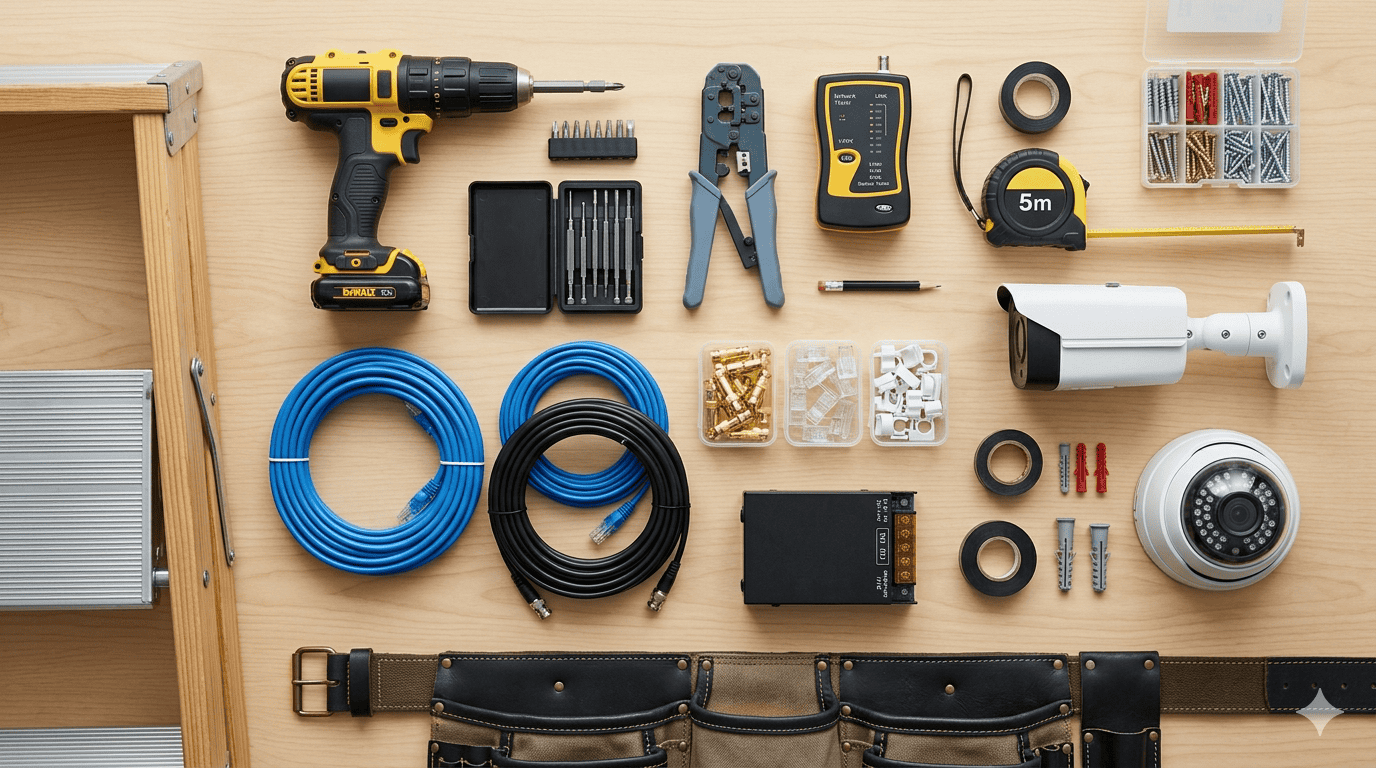
Security Camera Installation Tools and Equipment Checklist: Everything a Professional Brings to Site
The difference between a professional CCTV installation and a DIY job that looks like an afterthought usually comes down to tools — not skill, not experience, just the right tools used correctly. This checklist covers every tool and piece of equipment a professional security camera installer needs on site, why each one matters, and what happens when you try to substitute or skip it.
Master Tool Checklist at a Glance
Use this as your pre-job checklist before leaving for any installation site. Items marked Essential are non-negotiable for any professional installation. Items marked Situational depend on the specific job.
| Tool / Item | Category | Status | Approx. Cost (KES) |
|---|---|---|---|
| Hammer drill (SDS or standard) | Drilling | Essential | 4,500 – 15,000 |
| Masonry drill bits (6mm, 8mm, 10mm) | Drilling | Essential | 500 – 1,500 per set |
| Long wood/masonry bit (400mm+) | Drilling | Essential | 400 – 900 |
| Phillips and flathead screwdrivers | Mounting | Essential | 300 – 800 per set |
| Cordless screwdriver / impact driver | Mounting | Essential | 3,000 – 9,000 |
| BNC crimping tool | Cable termination | Essential (analog) | 800 – 2,500 |
| RJ45 crimping tool | Cable termination | Essential (IP) | 700 – 2,000 |
| Cable stripper / cutter | Cable preparation | Essential | 400 – 1,200 |
| Network cable tester | Testing | Essential (IP) | 800 – 2,500 |
| Multimeter | Testing | Essential | 1,200 – 3,500 |
| CCTV video tester / monitor | Testing | Essential | 8,000 – 25,000 |
| Fish tape / cable puller | Cable routing | Essential | 1,500 – 4,000 |
| Spirit level | Mounting | Essential | 300 – 800 |
| Measuring tape (5m minimum) | Planning | Essential | 300 – 700 |
| A-frame ladder (2–3m) | Access | Essential | 3,500 – 9,000 |
| Extension ladder (4–6m) | Access | Situational | 5,000 – 14,000 |
| Cable ties (assorted) | Cable management | Essential | 200 – 600 per pack |
| Cable trunking / conduit | Cable management | Essential | 150 – 400 per metre |
| Silicone sealant | Weatherproofing | Essential | 400 – 900 per tube |
| Wall plugs and rawl bolts (assorted) | Mounting | Essential | 200 – 600 per pack |
| Laptop or tablet (for DVR/NVR config) | Configuration | Essential | — |
| Torch / headlamp | Access | Essential | 500 – 1,500 |
| Fiberglass rods / cable guide rods | Cable routing | Situational | 2,000 – 5,000 |
| Punchdown tool | Cable termination | Situational | 800 – 2,000 |
| Angle grinder / hacksaw | Cable management | Situational | 2,500 – 8,000 |
| Safety glasses and dust mask | PPE | Essential | 500 – 1,500 |
| Work gloves | PPE | Essential | 300 – 800 |
Drilling and Mounting Tools
In Kenya, almost every CCTV installation involves drilling into concrete block walls, stone, or reinforced plaster. This is not a job for a standard domestic drill — and using the wrong drill is one of the most common reasons installations take twice as long as they should.
Hammer Drill
A hammer drill combines rotation with a hammering action to break through masonry without burning out the motor. For the typical Kenyan home installation — breeze block walls, stone walls, and concrete pillars — a hammer drill is the minimum. SDS-Plus drills are the professional standard, accepting a wide range of bit types and handling sustained drilling through dense materials without overheating. A decent 650W hammer drill costs KES 4,500–8,000. Professional SDS-Plus models from brands like Bosch or Makita run KES 10,000–18,000 and will last years of daily commercial use.
An ordinary drill with a masonry bit will work on soft brick or plaster but will struggle with dense concrete, generate excessive heat, and likely fail mid-job on harder surfaces. Do not bring a standard drill to a CCTV installation on a concrete-construction property.
Drill Bits
Masonry bits in 6mm, 8mm, and 10mm cover the bracket mounting requirements for almost all camera types. The 6mm bit matches standard M6 wall plugs used for lighter camera brackets. The 8mm and 10mm bits are used for heavier mounts, conduit saddle clips, and cable trunking fixings.
A long masonry bit — 300mm to 500mm — is essential for drilling through walls to pass cables from outside to inside. This is used at every outdoor camera position and at the DVR/NVR cable entry point through the wall. Without a long bit, the only option is surface-mounting cable on both sides of the wall, which looks unprofessional and leaves cable exposed to tampering and weather on the outside.
Many older Nairobi properties use stone construction — quarried volcanic rock — which is harder than standard concrete block and kills cheap masonry bits quickly. Keep spare bits on site. A professional installer typically carries at least three sets of bits per job to account for wear on harder materials.
Screwdriver Set and Impact Driver
Phillips-head screws dominate in camera mounting hardware, but flathead and occasionally Torx heads appear in DVR/NVR enclosures and conduit fittings. A manual set handles tight-space access where a power driver won’t fit. A cordless impact driver handles volume work — multiple camera brackets, trunking fixings, DVR rack mounts — far faster than manual driving and with consistent torque that won’t strip soft alloy bracket screws.
Cable Preparation and Termination Tools
Cable termination is where most amateur installations fall apart. Badly crimped BNC connectors cause signal loss on analog systems. Incorrectly wired RJ45 connectors cause intermittent or failed PoE on IP systems. These problems are often invisible during initial testing and only appear weeks later under temperature changes or vibration — by which point diagnosing them requires re-testing every connection on the run.
BNC Crimping Tool (Analog Systems)
Compression BNC connectors — the professional standard over twist-on types — require a dedicated crimping tool to seat the outer ferrule correctly around the coaxial cable shielding. The two components of the crimp tool head must match the connector type being used: 75-ohm compression connectors require a specific die that is not interchangeable with other coaxial types. A quality BNC compression crimper costs KES 1,200–2,500. The cheap twist-on BNC connectors that require no tool are a shortcut that experienced installers avoid — the connection is less mechanically secure and more prone to signal loss, particularly on outdoor runs where thermal expansion and contraction stress the joint.
RJ45 Crimping Tool (IP Systems)
For Cat6 cable termination, a ratchet-action RJ45 crimper gives consistent crimp force across all eight conductors. The ratchet mechanism prevents under-crimping — a common failure with cheap lever-only tools where the operator releases pressure before the crimp is complete. Ensure the tool is rated for Cat6 connectors specifically, as Cat5e and Cat6 connectors have slightly different dimensions. Cost: KES 700–2,000.
Cable Stripper and Cutter
A dedicated coaxial cable stripper removes the outer jacket, shielding, and inner insulation in a single pass at the correct depths for BNC connector termination. Using a blade or scissors to strip coaxial cable almost always results in nicked inner conductors or damaged shielding — both of which cause signal problems. A coaxial cable stripper costs KES 400–900 and pays for itself on the first job in saved troubleshooting time.
For Cat6 cable, a combined stripper/cutter that removes the outer jacket cleanly without cutting the inner pairs is the professional tool. The inner pairs should never be stripped with a blade — the thin insulation on each individual conductor is easily nicked, which causes wiring faults that pass a basic continuity test but fail under load.
Punchdown Tool
Used when terminating Cat6 cable into keystone jacks or patch panels rather than RJ45 connectors. Relevant for installations that route cable to a central distribution point rather than directly to the NVR. The punchdown tool seats each conductor into its IDC slot and cuts the excess in one motion. Without it, manually pushing conductors into IDC slots is unreliable and leaves untrimmed conductor ends that can short against adjacent contacts.
Testing and Diagnostic Tools
Testing tools are what separate installers who deliver a working system from those who leave and hope for the best. Every cable run should be tested before the wall is sealed or the trunking is closed. Every camera should be verified before the ladder comes down. Every DVR channel should be confirmed recording before the client signs off.
CCTV Video Tester / Portable Monitor
A CCTV video tester is a handheld device that displays the live camera feed, typically with a 4–7 inch screen. Its critical function is allowing the installer to verify the camera image, adjust the angle and focus, and confirm the cable connection is working while still up the ladder — before climbing down, moving the ladder, and then discovering the image is angled incorrectly or the cable has a fault.
Modern multi-function CCTV testers display analog (CVBS, AHD, TVI, CVI) and IP camera feeds, test PoE delivery, and often include a built-in cable toner and TDR (time-domain reflectometer) for locating faults on long cable runs. A basic analog tester costs KES 3,500–8,000. A professional multi-function unit with IP and PoE testing costs KES 15,000–30,000 and is one of the most valuable investments a professional installer can make.
An installer without a portable video tester must carry the camera image all the way back to the DVR monitor to verify each camera — climbing up and down the ladder multiple times per camera to adjust angle and confirm the image. A professional with a tester adjusts and verifies each camera position in a single ladder visit. On a 4-camera job, this difference alone saves 30–60 minutes of installation time.
Network Cable Tester
For IP installations, a network cable tester verifies that all eight conductors in a Cat6 run are correctly wired, continuous, and in the right order. A basic pass/fail tester checks continuity on all eight conductors sequentially — sufficient for confirming a cable run is correctly terminated. Cost: KES 800–1,500. A more advanced tester with TDR capability can also measure cable length and locate the precise distance to a fault — worth the investment for commercial installations with long cable runs. Cost: KES 3,000–8,000.
Multimeter
A digital multimeter is the universal diagnostic tool for any electrical installation. For CCTV specifically, it is used to verify 12V DC power delivery at camera positions before mounting the camera, to confirm that PoE voltage is present at the end of a Cat6 run, to test the continuity of alarm cable connections, and to diagnose power supply faults. Any multimeter with DC voltage and continuity measurement functions is sufficient. Cost: KES 1,200–2,500 for a reliable basic model.
PoE Tester
A dedicated PoE tester confirms both the presence and wattage of PoE power on an ethernet cable — useful when troubleshooting cameras that are connected but not powering on. While a multimeter can confirm voltage, a PoE tester reads the actual wattage available, which is important for cameras with higher power requirements (PTZ cameras, cameras with built-in illuminators) that may need a higher-wattage PoE port. Cost: KES 2,000–5,000 for a basic unit.
Cable Management and Routing Equipment
A clean cable installation that will still look professional in five years requires more than just running cable from A to B. Every cable needs to be protected, supported, labelled, and routed in a way that is maintainable and resistant to Kenya’s climate conditions.
Fish Tape / Cable Puller
A fish tape is a flat, coiled steel or fibreglass tape that is pushed through walls, ceiling voids, and conduit to create a guide path for pulling cables through. Indispensable for any installation where cables need to travel through an inaccessible void — through a concrete wall, across a ceiling space, or through pre-installed conduit. A steel fish tape with a 10m capacity costs KES 1,500–2,500. A fibreglass fish tape (preferred because it does not conduct electricity and is less prone to kinking) costs slightly more.
Fibreglass Push/Pull Rods
Where fish tape is too stiff to navigate corners or too short for long runs, interlocking fibreglass rods are the professional solution. They connect in 1m sections, can be pushed around corners that fish tape cannot negotiate, and are available in both flexible and rigid configurations. Used regularly on commercial installations where cables route through multiple ceiling sections or through conduit with bends. Cost: KES 2,000–5,000 for a basic set.
Cable Trunking and Conduit
Surface-mounted cables on outdoor walls must be protected in trunking or conduit. PVC rectangular trunking (also called cable duct or trunking) is the standard for indoor surface runs along walls and ceilings. PVC round conduit is used for outdoor runs, underground crossings, and runs through concrete. Both snap together without adhesive for neat installation and can be cut to length with a hacksaw or trunking saw. Keep an assortment of corner pieces, T-junctions, and end caps to complete runs neatly — exposed cut ends and raw corners are the telltale sign of an amateur installation.
Cable Ties and Clips
Nylon cable ties in 100mm, 150mm, and 200mm lengths handle bundling cables at regular intervals within trunking and at junction points. Self-adhesive cable clips fix individual cables to smooth surfaces without drilling. Stainless steel cable ties are worth carrying for outdoor applications where UV and moisture would degrade standard nylon ties over time. A bulk pack of mixed cable ties costs under KES 500 and runs out faster than expected on a multi-camera job.
Cable Labels
Pre-printed or write-on cable markers that wrap around the cable and stay readable for years. Applied at both ends of every cable run — camera end and DVR/NVR end — referencing the camera label and channel number. Without physical labels, the only way to identify which cable connects to which camera is to follow the run physically, which on a concealed installation means significant disruption. A roll of self-laminating cable markers costs KES 500–1,200 and is one of the most underused tools in Kenya’s installation market.
Access Equipment
Most CCTV cameras are mounted between 2.5 and 5 metres above ground level. Getting to that height safely and efficiently requires the right ladder for the specific installation context.
A-Frame (Step) Ladder
The standard access tool for indoor installations and lower outdoor mounts. A 2.5m A-frame ladder provides safe working height to reach a 3.5m ceiling or external wall soffit. Look for aluminium construction — lighter than steel and does not rust in outdoor conditions. A quality aluminium A-frame costs KES 3,500–7,000. Do not use a domestic paint ladder for CCTV work — the load rating is insufficient for a technician plus tools and the build quality is not suited to repeated daily use.
Extension Ladder
For installations on external compound walls (typically 2–3m high with the camera bracket adding another metre), a gate pillar, or any position that cannot be safely reached with an A-frame, an extension ladder is required. A 4–6m two-section aluminium extension ladder covers the vast majority of Kenyan residential and commercial installations. Cost: KES 5,000–12,000. Carry ladder standoffs (wall hooks that hold the ladder away from the wall surface) to prevent the ladder from damaging gutters or masonry and to maintain a safe working angle.
Torch and Headlamp
Work inside ceiling voids, behind DVR cabinets, and in electrical distribution areas requires hands-free lighting. A headlamp that clips to a hard hat or worn directly allows both hands to remain free for cabling work in dark spaces. A bright LED headlamp costs KES 500–1,500 and is one of those tools that seems unnecessary until you are halfway into a cable void with no light and both hands occupied with fish tape.
Power and Electrical Tools
Angle Grinder or Hacksaw
Used for cutting metal conduit, metal cable tray sections, and occasionally for chasing small cable channels in plaster. An angle grinder with a thin cutting disc is faster but requires PPE and care around camera equipment. A hacksaw is adequate for most conduit cutting needs and carries no risk of disc failure. Situational — not needed on every job but essential on commercial installations with metal infrastructure.
Hot Knife / Trunking Cutter
A hot knife melts through PVC trunking cleanly, producing a smooth cut edge without the rough plastic burrs left by a hacksaw. Relevant for high-volume commercial installations where the quality of every cut shows in the finished result. Less critical for basic residential jobs where a hacksaw and light sanding produces an acceptable finish.
Electric Extension Lead
A 10m or 15m extension lead with a surge-protected multi-socket allows power tools to reach all areas of an installation without depending on the client’s existing sockets or running individual extension leads from multiple points. Carry a 4-socket unit minimum — drill, charger, laptop, and video tester may all need power simultaneously.
Finishing and Weatherproofing Supplies
The quality of an outdoor CCTV installation is measured partly by how it looks after six months of Nairobi weather. Exposed cable entries without sealant fill with water. Untreated bracket fixings rust and stain walls. Cable trunking that was not bonded to outdoor surfaces correctly peels off in the heat. These finishing details are what separate a durable professional installation from one that starts failing within the first rainy season.
Silicone Sealant
Applied around every cable entry point where a cable passes through an external wall — the hole through which the cable enters the building, the entry point into outdoor camera housings, and any gap between trunking and wall surfaces that could allow water ingress. Clear or white neutral-cure silicone is the standard. Acid-cure silicone (the type with a vinegar smell during curing) should not be used near metal camera housings or electronics — the acetic acid it releases during curing causes corrosion. A 300ml cartridge costs KES 400–900 and requires a caulking gun to apply.
Rawl Plugs and Anchor Bolts
Standard red and yellow wall plugs work for standard brick and block. For stone walls and dense concrete, use fischer or heavy-duty nylon plugs that resist pull-out forces better than soft-shank domestic plugs. Stainless steel self-tapping screws rather than zinc-plated screws for outdoor brackets — zinc plating corrodes in Kenya’s humid conditions within 12–18 months, while stainless holds for the life of the installation. The cost difference per screw is under KES 5 and the difference in longevity is years.
Weatherproof Junction Box Sealant
Outdoor cable connection points should be sealed in IP-rated junction boxes with self-amalgamating tape or silicone applied at cable entry points. Self-amalgamating tape — a rubber tape that bonds to itself without adhesive — is the professional solution for waterproofing BNC or RJ45 connections that are exposed to weather. It creates a completely sealed, moisture-proof joint that outlasts any other temporary weatherproofing method. A roll costs KES 600–1,200.
Configuration and Commissioning Equipment
The physical installation is only half the job. Configuring the system correctly, verifying every function, and handing over a working system to the client requires its own set of tools.
Laptop or Tablet
Required for accessing the DVR/NVR web interface for initial configuration, firmware updates, and network settings. Many professional installers use a tablet rather than a laptop because it is lighter and easier to hold while navigating menus standing in front of a mounted DVR. Ensure the device can connect via ethernet for direct DVR access — Wi-Fi only devices cannot access a DVR before the network is configured. Keep the device charged — DVR configuration on a complex job can take 1–2 hours.
Short Ethernet Patch Cable
A 1m or 2m Cat6 patch cable for direct connection between the laptop and DVR/NVR during configuration. Carry two — one for the DVR and one spare. This is the kind of item that is never available on site if you forget to bring it.
Smartphone with Hik-Connect / DMSS / EZVIZ App
Remote viewing configuration and push notification testing must be verified on the actual device the client will use, or on the installer’s own device before client handover. Having the app pre-installed and familiar with the setup process saves significant time on site. Also used to confirm the system is accessible from outside the local network — using mobile data rather than the property’s Wi-Fi is the correct test.
USB Drive
Required for firmware updates on DVRs and NVRs that don’t support over-the-air updates, for exporting test footage to verify recording quality, and for transferring configuration backup files. A standard 16GB USB drive is sufficient — keep one in the toolkit permanently.
HDMI Cable
For connecting the DVR/NVR to a display during initial configuration and client demo. Carry a 2m HDMI cable — long enough to reach a nearby TV or monitor in most installation locations without needing the client to move their TV.
Safety and PPE
CCTV installation involves drilling overhead, working at height, handling sharp connectors, and occasionally working in enclosed spaces. The PPE requirements are modest but non-negotiable for professional practice.
| PPE Item | When Required | Cost (KES) |
|---|---|---|
| Safety glasses / goggles | Any overhead drilling, angle grinder use, cable pulling through conduit | 400 – 900 |
| Dust mask (N95 or FFP2) | Drilling concrete or stone, working in dusty ceiling voids | 150 – 400 per mask |
| Work gloves (cut-resistant) | Handling metal conduit, cut cable ends, sharp camera housing edges | 400 – 900 |
| Hard hat | Working below overhead drilling operations, commercial sites with overhead hazards | 800 – 2,000 |
| Non-slip footwear | Any ladder work, wet surfaces, roof access | 2,500 – 5,000 |
| High-visibility vest | Commercial site work, car park or road-adjacent installations | 500 – 1,200 |
Ladder safety deserves particular emphasis. The majority of serious injuries in installation work involve falls from ladders. Three-point contact rule (two feet and one hand, or two hands and one foot on the ladder at all times), correct ladder angle (1:4 ratio — 1m out for every 4m up), and never reaching beyond arm’s length while on a ladder are basic protocols that should be habit, not occasional practice.
Tools That Differ: Analog vs IP Installations
The toolkit is largely the same for both system types, but there are meaningful differences in the cable termination and testing tools required:
| Tool | Analog (DVR) System | IP / PoE (NVR) System |
|---|---|---|
| Cable type | RG59 Siamese coaxial | Cat6 ethernet |
| Crimping tool | BNC compression crimper | RJ45 ratchet crimper |
| Cable stripper | Coaxial cable stripper | Cat6 / UTP cable stripper |
| Cable tester | Basic coaxial continuity tester | 8-conductor network cable tester |
| Power verification | Multimeter at 12V DC adaptor output | PoE tester or multimeter at NVR port |
| Video verification | CCTV video tester (CVBS/AHD/TVI) | CCTV video tester with IP support, or laptop with ONVIF viewer |
| Punchdown tool | Not required | Required if using keystone jacks |
An installer who regularly handles both analog and IP systems should carry both crimping tools and both cable strippers. Attempting to terminate Cat6 with a coaxial stripper, or crimping RJ45 connectors with a BNC tool, produces unreliable connections that create callbacks and rework.
Where to Buy Installation Tools in Kenya
Most of the tools on this list are available in Nairobi through the following channels:
Luthuli Avenue and River Road
The main electronics and security supplies corridor in Nairobi CBD stocks BNC crimpers, cable strippers, cable testers, video testers, fish tape, cable trunking, and connectors. Prices are competitive and it is possible to compare several suppliers in a single visit. Be selective about quality — cheap crimping tools from the lower end of the market produce inconsistent crimps that cause installation callbacks.
Specialist Security Suppliers
Companies like AreaSpy Security Kenya stock professional-grade installation tools alongside the camera systems they sell. Buying tools from the same supplier as your cameras ensures compatibility — particularly relevant for BNC connector types and Cat6 termination standards. Specialist suppliers can also advise on the correct tool for specific connector brands.
Hardware Stores (Nairobi and Satellite Towns)
General hardware stores handle the physical installation side — drill bits, masonry anchors, cable trunking, conduit, silicone sealant, screws, and cable ties. Larger stores like Buildmart, Tuffchem, and building materials specialists carry the full range. For installations outside Nairobi, hardware supplies are available in most county towns but specialist electronic tools may need to be sourced from Nairobi and carried to site.
Online (Jumia Kenya, Jiji)
Convenient for price comparison, particularly for power tools. Verify seller ratings and check return policies before purchasing expensive items like hammer drills or professional cable testers online. Delivery reliability to addresses outside Nairobi varies.
The DIY Reality: Which Tools You Can Skip and Which You Cannot
If you are considering a DIY installation for a simple home CCTV system, here is an honest breakdown of where corners can be cut and where they absolutely cannot:
| Tool | Can You Skip It? | Consequence if Skipped |
|---|---|---|
| Hammer drill | No | Unable to drill through concrete walls. Overheated standard drill. Installation stalls. |
| BNC / RJ45 crimping tool | No | Use pre-made cables instead. If making your own runs, unreliable connections guaranteed without proper crimper. |
| Cable tester | Risky | Faulty runs only discovered at commissioning stage after all cables are concealed. Fault-finding becomes very expensive. |
| Video tester / portable monitor | Yes — with workaround | Multiple trips up/down ladder to verify each camera at DVR. Inefficient but functional for small installations. |
| Fish tape | Only if no concealed routing | Without fish tape, all cables must be surface-mounted. Functional but less professional appearance. |
| Spirit level | No | Crooked cameras are immediately visible and permanently annoying. Costs nothing to use correctly. |
| Silicone sealant | No | Outdoor cable entries allow water ingress. Cables and connectors fail within one rainy season. |
| Proper ladder | No | Working at height on an inadequate ladder is a safety risk, not an inconvenience. |
| PPE (glasses, dust mask) | No | Overhead concrete drilling produces dense dust and occasional concrete chips. Eye injuries are real and permanent. |
The practical conclusion for most DIY installers: buying pre-terminated cables (Siamese with pre-fitted BNC connectors for analog, or pre-made Cat6 patch cables for short IP runs) eliminates the need for crimping tools and cable strippers on small installations. Everything else on the essential list genuinely cannot be substituted without compromising either safety or installation quality.
Frequently Asked Questions
What is the most important tool a CCTV installer should carry?
The hammer drill — because without it, a professional installation on Kenyan masonry construction simply cannot be completed. But the most undervalued tool that separates fast professional installations from slow ones is the CCTV video tester. Being able to verify camera image, angle, and cable quality from the ladder rather than making repeated trips to the DVR monitor is the single biggest time-saver in the field.
Can I use a regular drill instead of a hammer drill for mounting cameras?
On soft brick or plaster walls, a standard drill with masonry bits will manage. On the dense concrete block, stone, and reinforced construction common in Nairobi and Kenyan towns generally, a standard drill will overheat, the bit will lose its edge quickly, and you may not be able to complete the hole at all. For any installation involving outdoor walls or concrete construction, a hammer drill is the only practical tool.
Do I need different tools for analog and IP CCTV systems?
The core toolkit — drill, ladder, level, silicone, trunking, cable ties — is identical for both. The cable termination and testing tools differ: analog requires a BNC crimper and coaxial cable stripper, while IP requires an RJ45 crimper, Cat6 cable stripper, and network cable tester. If you regularly install both system types, carry both sets. They cost relatively little and eliminate the risk of arriving at a job without the right termination tool.
Where can I get a CCTV video tester in Nairobi?
CCTV video testers are available from specialist security suppliers on Luthuli Avenue in the Nairobi CBD and from dedicated security equipment companies. Basic analog-only testers are readily available. Multi-function testers supporting IP cameras and PoE testing are less commonly stocked — order from a specialist supplier and confirm the unit supports the camera brands you install (Hikvision, Dahua, EZVIZ) to ensure compatibility with the specific signal formats used.
How do I run cable through a concrete wall without making a large hole?
Use a long masonry bit — 300mm to 500mm in length — at the smallest diameter that will accommodate the cable. A 10mm hole is sufficient to pass a Siamese cable or Cat6 cable through a wall. Drill at a slight downward angle on the outside to ensure any water that enters the hole drains outward rather than running into the building. Seal the gap around the cable with silicone sealant from both sides after the cable is in position.
How long does a professional toolkit for CCTV installation cost to assemble?
A basic but professional toolkit covering all the essentials — hammer drill, drill bits, BNC and RJ45 crimpers, cable strippers, cable tester, video tester, fish tape, ladder, level, silicone and consumables — typically runs KES 35,000 to KES 70,000 to assemble from new. A professional who already owns a hammer drill and ladder may assemble the CCTV-specific additions for KES 15,000–25,000. These are one-time costs amortised across many installations.
The Right Tool for Every Step
A CCTV installation done with the right tools looks professional on the day it is completed and continues to look and perform professionally years later. Tight cable runs in conduit, correctly terminated connectors, levelled cameras sealed against the weather, labelled cables at both ends — these are the marks of a job done with proper equipment and professional intent.
For property owners evaluating installers, asking to see a technician’s toolkit is a legitimate question. A professional who arrives with a proper hammer drill, video tester, cable tester, and full set of termination tools is demonstrably better equipped than one who arrives with a domestic drill and a bag of twist-on BNC connectors. Equipment reflects intent — and intent determines outcomes.
Professional Tools, Professional Results
Every AreaSpy installation is completed by trained technicians with professional-grade tools — hammer drills, video testers, cable testers, proper termination equipment, and all the finishing materials for a clean, durable installation. Request a free site assessment below.