
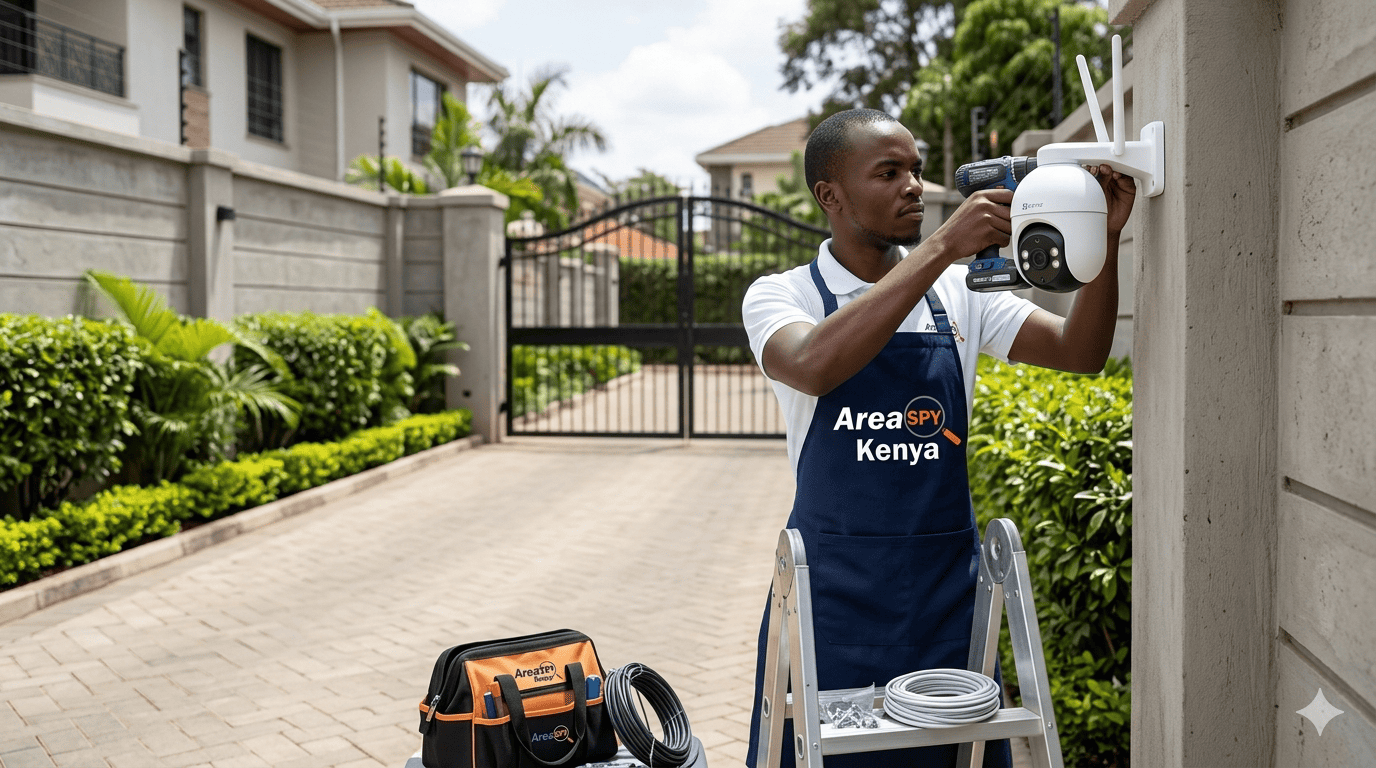
Cost of CCTV Installation in Kenya: What You’ll Actually Pay in 2026
If you’ve been quoted three different prices by three different installers, you’re not alone. CCTV pricing in Kenya is all over the place — and that can make budgeting feel impossible. This guide cuts through the noise, gives you real numbers, and tells you exactly what you should (and shouldn’t) be paying.
Quick Cost Summary
Before getting into the details, here’s a straightforward overview of what CCTV installation actually costs in Kenya right now. These are realistic figures based on current market pricing, inclusive of cameras, DVR/NVR, cabling, hard disk, and professional labour:
| System Size | Camera Type | Estimated Total Cost (KES) | Best For |
|---|---|---|---|
| 2–3 Cameras | Analog HD | KES 18,000 – 30,000 | Small apartment, kiosk, home office |
| 4 Cameras | Analog HD | KES 25,000 – 45,000 | Standard home, small shop |
| 4 Cameras | IP / Network | KES 45,000 – 90,000 | Home with remote viewing needs |
| 8 Cameras | Analog HD | KES 45,000 – 85,000 | Larger home, SME, warehouse |
| 8 Cameras | IP / Network | KES 80,000 – 150,000 | Office block, school, fuel station |
| 16 Cameras | IP / Network | KES 150,000 – 280,000 | Commercial premises, apartment blocks |
These prices include all core components: cameras, recording unit, 1TB or 2TB hard disk, cabling, connectors, and installation labour. A quote that doesn’t specify these components is almost certainly incomplete.
What Actually Determines the Price?
There’s no universal rate card for CCTV in Kenya — and that’s not a bad thing. It means the price should reflect your actual situation. Here are the main factors that will move your quote up or down:
Number of Cameras
This is the biggest cost driver. Every additional camera means another unit, power supply, cabling run, and installation time. That said, the cost per camera generally drops as you scale up — an 8-camera system doesn’t cost double a 4-camera system once you account for shared DVR/NVR, cabling infrastructure, and labour efficiencies.
Resolution and Image Quality
Resolution is measured in megapixels (MP). A 2MP camera produces 1080p footage — this is the baseline for most professional installations in Kenya today. Moving up to 4MP or 8MP (4K) gives you noticeably sharper images, which makes a real difference when you’re trying to identify a face or a number plate from a distance. Higher resolution cameras cost more and also require larger hard drives for storage.
| Resolution | Megapixels | Camera Price (KES) | Best Use Case |
|---|---|---|---|
| 1080p | 2MP | KES 2,500 – 6,000 | General home/office surveillance |
| 4MP | 4MP | KES 5,000 – 12,000 | Entrances, car parks, retail |
| 4K / 8MP | 8MP | KES 12,000 – 25,000 | Banks, schools, critical points |
Indoor vs Outdoor Installation
Outdoor cameras are IP66 or IP67-rated, meaning they’re sealed against dust and rain. They’re built tougher and cost slightly more. More importantly, outdoor installation takes longer — cable runs tend to be longer, conduit or trunking is needed to protect cables from weather and tampering, and drilling through walls and ceiling soffits adds time to the job.
DVR vs NVR Recording
Analog systems use a DVR (Digital Video Recorder), which connects via coaxial cable. IP systems use an NVR (Network Video Recorder), which connects via Cat6 ethernet or Wi-Fi. NVRs are generally more expensive but offer better scalability and remote access capabilities. A decent 4-channel DVR starts around KES 8,000, while an equivalent NVR begins around KES 12,000–15,000.
Hard Drive / Storage Capacity
Footage has to be stored somewhere. A 1TB surveillance-grade hard drive can hold roughly 7–14 days of continuous footage from a 4-camera 1080p system. A 2TB drive doubles that. Hard drives specifically rated for 24/7 write cycles cost between KES 7,000 and KES 18,000 depending on capacity. Don’t let any installer put a desktop-grade drive in your CCTV system — they fail quickly under constant recording load.
Location and Site Complexity
A single-storey maisonette in Kiambu is a straightforward installation. An eight-floor apartment block in Westlands is not. Factors like ceiling height, concrete walls, distance between camera points, conduit requirements, and the need for a dedicated monitor or TV connection all affect how long the job takes — and therefore what you pay for labour.
Camera Types and Their Costs in Kenya
Walk into any security supplies shop on Luthuli Avenue in Nairobi and you’ll find a wall of camera options. Understanding what you’re looking at makes the difference between buying the right tool and wasting money.
Bullet Cameras
The classic long-barrel camera that most people picture when they think of CCTV. Great for long-distance outdoor coverage — driveways, perimeter walls, parking lots. Highly visible (which deters intruders) and easy to aim. Prices start around KES 2,500 for a 2MP unit from a reputable brand.
Dome Cameras
Discreet ceiling-mount cameras with a vandal-resistant casing. Popular for indoor use — supermarkets, offices, hotel lobbies, corridors. The dome housing makes it hard to tell which direction the camera is pointing, which adds a psychological deterrence layer. Comparable in price to bullet cameras at the same spec level.
PTZ (Pan-Tilt-Zoom) Cameras
Motorized cameras that can pan left/right, tilt up/down, and zoom in optically. Ideal for large open spaces like school compounds, warehouses, and parking areas where one camera needs to cover a wide zone. These are high-end units — expect to pay KES 20,000 to KES 80,000+ per camera. Labour for PTZ installation is also more involved due to power and network demands.
Wireless / Wi-Fi Cameras
These cameras connect to your router instead of running cables back to a DVR. The appeal is obvious — minimal cabling, easier installation, more flexibility. The trade-off is reliability: Wi-Fi signal degrades over distance, thick concrete walls (very common in Kenyan construction) block signals, and power still needs to reach the camera. Best suited for smaller setups where cabling is genuinely impractical. Expect to pay KES 5,000 to KES 25,000 per unit for quality wireless cameras.
PoE (Power over Ethernet) IP Cameras
These are IP cameras powered through their network cable — a single Cat6 cable delivers both data and power. Extremely clean installation, easy to scale, and generally the preferred choice for any serious installation today. They require a PoE switch or PoE NVR. A good PoE IP camera from Hikvision or EZVIZ starts around KES 5,000 to KES 10,000.
For most Kenyan homes and small businesses, a 2MP or 4MP PoE IP system with a good NVR gives you the best balance of image quality, remote access convenience, and long-term reliability. It costs slightly more upfront than analog but is cheaper to expand later.
Package Breakdowns: Homes vs Businesses
Rather than giving you abstract price ranges, here’s what a properly specified installation actually looks like — component by component — for the most common scenarios we see in Kenya.
Standard Home: 4 Camera Analog HD System
This is the most common entry-level installation for a 3–4 bedroom house. It covers front gate, back door, driveway, and one common area.
| Component | Specification | Cost (KES) |
|---|---|---|
| 4× Outdoor Bullet Cameras | 2MP / 1080p, 30m IR range | 10,000 – 16,000 |
| 4-Channel DVR | HD-TVI, H.265 compression | 7,000 – 10,000 |
| 1TB Surveillance HDD | WD Purple or Seagate SkyHawk | 7,000 – 9,000 |
| Cabling & Accessories | Siamese cable, connectors, trunking | 3,000 – 5,000 |
| Installation Labour | Professional installation, config, app setup | 5,000 – 8,000 |
| Total | KES 32,000 – 48,000 |
Home Upgrade: 4 Camera IP / PoE System
Same size installation, but upgraded to IP cameras with remote viewing on your phone, smarter motion detection, and cleaner cabling.
| Component | Specification | Cost (KES) |
|---|---|---|
| 4× PoE IP Cameras | 2MP / 4MP, colour night vision | 20,000 – 36,000 |
| 4-Channel PoE NVR | H.265+, HDMI output | 12,000 – 18,000 |
| 2TB Surveillance HDD | WD Purple | 9,000 – 13,000 |
| Cat6 Cable & Accessories | Structured cabling, keystones, trunking | 4,000 – 7,000 |
| Installation Labour | Professional installation, remote app setup | 7,000 – 12,000 |
| Total | KES 52,000 – 86,000 |
Business Premises: 8 Camera Commercial System
For a mid-size business — retail shop, small office, petrol station, school classroom block. This system provides meaningful coverage with proper storage and backup capacity.
| Component | Specification | Cost (KES) |
|---|---|---|
| 8× IP Cameras (mix indoor/outdoor) | 4MP, H.265, IR + colour modes | 40,000 – 70,000 |
| 8-Channel PoE NVR | Supports up to 16 channels, remote access | 18,000 – 28,000 |
| 2–4TB Surveillance HDD | 30 days storage at full resolution | 12,000 – 22,000 |
| Structured Cabling | Cat6, conduit, patch panels | 8,000 – 15,000 |
| UPS Backup | Protects against power cuts | 8,000 – 15,000 |
| Installation Labour | 2-day professional installation | 12,000 – 20,000 |
| Total | KES 98,000 – 170,000 |
Analog vs IP: Which System Actually Makes Financial Sense?
This question comes up constantly. People see the lower upfront cost of analog and assume it’s the budget-smart choice. The reality is a bit more nuanced.
“An analog system is cheaper to install. An IP system is cheaper to own over five years.”
| Factor | Analog CCTV (DVR) | IP / Network CCTV (NVR) |
|---|---|---|
| Upfront cost (4 cams) | KES 25,000 – 45,000 | KES 50,000 – 90,000 |
| Image quality | Good (2MP standard) | Better (4MP–8K available) |
| Remote viewing | Possible but less reliable | Excellent via app |
| Expandability | Limited to DVR channels | Easily scalable |
| Cabling | Coaxial (thicker, less flexible) | Cat6 ethernet (easier to run) |
| Smart features | Basic motion detection only | AI detection, face recognition, LPR |
| Future-proofing | Limited | Strong |
Our recommendation: if your budget starts at KES 50,000, go IP from day one. If you’re genuinely cash-constrained and need basic coverage now, analog HD will serve you — but plan to transition within 3–5 years as you expand.
DIY Installation vs Professional — The Real Tradeoff
YouTube has made DIY CCTV installation look deceptively simple. Here’s an honest look at both paths:
What DIY Actually Saves You
Labour is typically KES 5,000 to KES 20,000 depending on system size. That’s the real saving. Equipment costs the same whether you install it yourself or hire a professional.
What DIY Costs You
- Improper camera placement leaves blind spots you won’t notice until after an incident
- Poor cable runs look messy, get damaged faster, and create interference in analog systems
- Most DIY installs don’t include proper weatherproofing on outdoor cable entries
- Remote viewing configuration — DDNS setup, port forwarding, P2P cloud — trips up most non-technical users
- Warranty claims are often voided if a non-certified technician installed the equipment
- No site survey means cameras are placed where convenient, not where they’re most effective
What Professional Installation Gets You
- Site survey to map camera positions for maximum coverage with minimum blind spots
- Clean, conduit-protected cable runs that last and look professional
- Correct camera angles and height settings for optimal footage quality
- Full system configuration including recording schedules, motion zones, and app setup
- Warranty protection on both labour and equipment
- Someone to call when something goes wrong
For a system you’re genuinely relying on for security, professional installation is worth the extra KES 5,000–20,000. The point of CCTV is that it works when you need it most — not that you saved some money setting it up.
How to Choose a CCTV Installer in Kenya Without Getting Ripped Off
There are hundreds of CCTV installers in Nairobi alone. Quality ranges from exceptional to outright dangerous. Here’s what separates the professionals from the amateurs:
Ask for an Itemised Quote
Any reputable installer will provide a written quote that lists each component — camera model, DVR/NVR model, hard drive brand and capacity, cable type, and labour. A quote that just says “4 camera CCTV system — KES 25,000” tells you nothing useful. If they can’t itemise it, walk away.
Check the Brand Names
Hikvision and Dahua are the two dominant professional-grade brands in Kenya, with EZVIZ (Hikvision’s consumer arm) being excellent for smaller installations. These brands have local distributors, genuine warranties, and long-term firmware support. Unbranded cameras from no-name Chinese factories might cost KES 1,000 less per unit but have no warranty path and often fail within 18 months.
Verify Experience with Your Type of Property
Installing cameras in a maisonette is different from wiring an apartment block or a supermarket. Ask if they’ve done similar projects and whether you can speak to a past client. Most legitimate security companies are happy to provide references.
Ask What Happens After Installation
What’s the warranty period on equipment and labour? Do they offer maintenance contracts? Who do you call if a camera stops working at midnight? After-sales support is where you find out who you’re really dealing with.
Don’t Confuse Price with Value
The cheapest installer may be cutting corners on cable quality, using refurbished hard drives, or skipping proper outdoor weatherproofing. The most expensive isn’t always the best. What you’re looking for is transparent pricing, named equipment brands, and a company that has skin in the game after the installation is done.
Nairobi Prices vs Upcountry — Is There a Difference?
Generally, equipment costs are the same or very close across Kenya — most installers source from the same distributors in Nairobi’s Luthuli Avenue or from suppliers like AreaSpy who import directly. What differs is labour.
In Nairobi and major towns like Nakuru, Eldoret, Mombasa, and Kisumu, there’s more competition among installers, which keeps labour rates in a reasonable range. For remote or difficult-to-access areas, expect travel costs to be added to the quote — usually transparently, as a day-rate or fuel reimbursement.
The genuine risk in smaller towns is finding a qualified installer at all. Many properties in upcountry Kenya end up with amateur installations done by IT technicians or electricians who’ve watched a few tutorials. If you’re installing in a remote area, it’s often worth having a reputable Nairobi-based company travel to site — the cost difference is usually recovered in the quality of the installation alone.
Frequently Asked Questions
How many cameras does a typical home in Nairobi need?
Most 3–4 bedroom homes in estates like Kasarani, Ruaka, Syokimau, or Kiambu are well-covered by 4 cameras: front gate, back door, driveway, and one indoor common area. A larger compound or a corner plot may need 6–8 cameras to eliminate blind spots.
Can I view my CCTV cameras on my phone when I’m abroad?
Yes. Modern IP and hybrid DVR systems support remote viewing via apps like Hik-Connect (Hikvision), DMSS (Dahua), or EZVIZ. As long as your recorder is connected to the internet, you can view live footage and playback from anywhere in the world.
How long does footage stay on the hard drive?
It depends on resolution and the number of cameras. A 1TB drive with four 2MP cameras recording continuously will hold approximately 7–10 days of footage. A 2TB drive with the same setup gives you 14–20 days. Most systems overwrite the oldest footage automatically when the drive is full.
Do I need Wi-Fi for a CCTV system to work?
No. Wired CCTV systems (analog and wired IP) operate entirely independently of your internet connection. Wi-Fi is only required if you want remote viewing on your phone. The cameras record to the local DVR/NVR regardless of internet availability.
Is there a legal requirement to display CCTV signs in Kenya?
Kenya’s Data Protection Act 2019 requires that people on premises with CCTV be aware that they are being recorded. For commercial and business premises, displaying clear CCTV signage is considered best practice and helps with compliance. For private residential property, the requirements are less stringent but displaying a notice is still advisable.
What’s the difference between Hikvision and EZVIZ?
EZVIZ is Hikvision’s consumer-focused brand. Both use largely the same imaging technology and manufacturing. Hikvision’s main product line is aimed at professional/commercial installations with more enterprise features, while EZVIZ focuses on plug-and-play ease of use for homes and small offices. Both are excellent choices — the right one depends on your use case and whether you’re doing self-installation or hiring a professional.
How much does a single CCTV camera cost to install in Kenya?
Labour for a single camera typically runs KES 1,500 to KES 3,000. However, it’s rarely practical to install one camera in isolation — the recording unit, power, and infrastructure costs make it more economical to install a complete system from the start rather than piecemeal.
The Bottom Line
CCTV installation in Kenya is genuinely affordable when you understand what you’re buying. A properly specified 4-camera analog system for a Nairobi home runs between KES 32,000 and KES 48,000 fully installed. A premium 4-camera IP system with colour night vision and remote viewing sits in the KES 52,000 to KES 86,000 range. Business-grade 8-camera setups typically land between KES 100,000 and KES 170,000 fully fitted.
What you want to avoid is the false economy of the cheapest possible quote. An under-specified camera in the wrong position using a failing hard drive doesn’t make your property safer — it just gives you a blinking light on the wall. When an incident happens, blurry footage from an improperly positioned camera has very limited value.
Invest in a system that’s correctly specified, properly installed, and supported by people who stand behind their work. It’s a one-time expense that pays for itself every day, long after the installation van drives away.
Get a Free Site Assessment from AreaSpy
Not sure exactly what your property needs? Our team conducts a free on-site security assessment — we’ll tell you exactly how many cameras you need, where they should go, and what a realistic budget looks like. No pressure, no vague estimates.